10 Tips for Choosing the Best King Size Mattress?
Choosing the right King Size Mattress involves more than selecting the largest option available. A standard king measures approximately 76 by 80 inches, offering generous personal space for couples, children, or pets. However, room size matters. The Better Sleep Council recommends leaving clear walking space around the bed, yet many shoppers overlook this practical detail.
Sleep quality should guide the decision. The Centers for Disease Control and Prevention recommends at least seven hours of sleep nightly for most adults. The American Academy of Sleep Medicine also connects consistent, sufficient sleep with better health and daytime performance. A mattress cannot solve every sleep problem. It can, however, influence pressure relief, spinal alignment, temperature, and movement transfer.
Industry research adds useful context. The International Sleep Products Association regularly reports changing bedding preferences, material trends, and consumer purchasing behavior. Meanwhile, sleep-health guidance from the National Sleep Foundation emphasizes comfort, support, and a stable sleep environment. These reports provide direction, not guaranteed answers. Bodies differ. Preferences change. Even expert advice may feel imperfect.
This guide explores ten practical tips for choosing a King Size Mattress. Expect details about firmness, foam density, coils, cooling fabrics, trial periods, warranties, and bedroom measurements. Consider testing a mattress for several minutes in your normal sleeping position. Check whether your shoulders sink naturally. Notice whether your lower back feels supported. Small observations matter. A beautiful mattress can still be the wrong mattress.
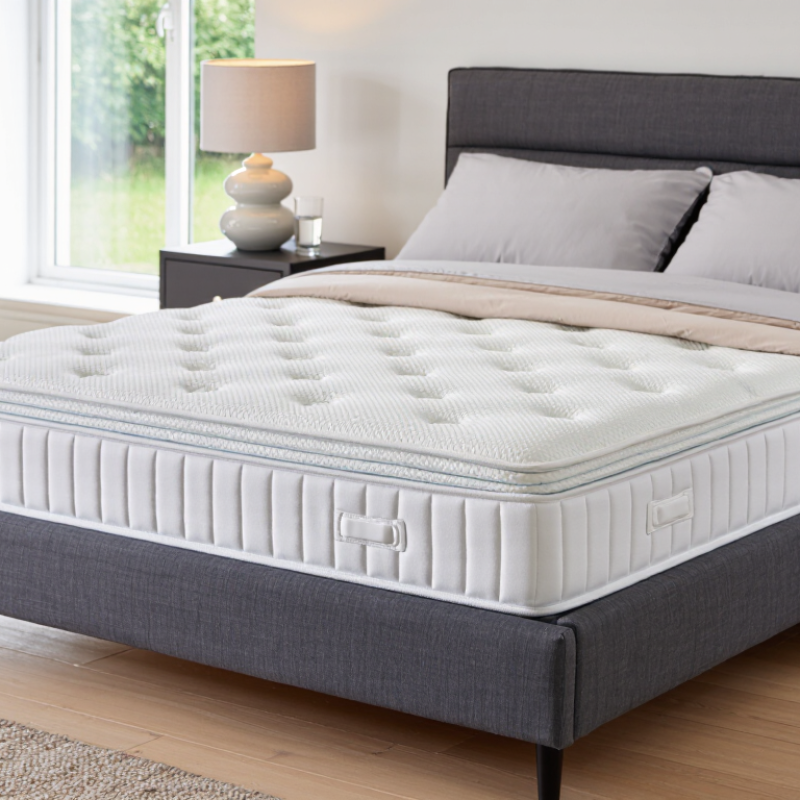
Confirm 76 × 80-Inch King Dimensions and Required Bedroom Clearance
10 Tips for Choosing the Best King Size Mattress?
A standard king mattress measures 76 × 80 inches, or about 193 × 203 centimeters. Sleep Foundation’s mattress-size guide confirms these dimensions. Measure the mattress, frame, headboard, and base together. I once overlooked a thick frame, and the planned walkway disappeared. Small errors matter.
Tip 1: Leave at least 24 inches beside the bed for basic movement. A 30- to 36-inch path feels more practical near doors and wardrobes. These figures are planning recommendations, not universal legal requirements. Check local building rules, especially in converted rooms.
Tip 2: Add the frame’s outer dimensions before buying. A king can occupy over 43 square feet before furniture enters the room.
Tip 3: Mark a 76 × 80-inch rectangle on the floor with painter’s tape. Open every door and drawer.
Tip 4: Keep outlets, vents, and heating units accessible.
Tip 5: Confirm stairway and doorway clearance for delivery.
The American Academy of Sleep Medicine recommends adults obtain at least seven hours of sleep, so comfort and room function both deserve attention. Sleep Research Society guidance also supports consistent sleep conditions. A larger bed may help couples move less, but it cannot fix poor ventilation, noise, or an unsuitable firmness level.
Measure twice. Rethink the layout.
Match Firmness to Sleep Position Using 12–31 ILD Comfort-Scale Data
Check Memory-Foam Density: At Least 4 lb/ft³ for Greater Durability
When choosing a king size mattress, inspect the memory-foam density before judging its softness. Aim for at least 4 lb/ft³ in the comfort layer. This level usually offers better resistance to body impressions and daily wear. Density matters. However, it does not guarantee perfect comfort. A dense foam can feel warmer, respond more slowly, and seem too firm for some sleepers.
I once preferred a softer mattress because it felt luxurious in a showroom. After several weeks, my hips sank deeper than expected. That experience changed my approach. Test the mattress for at least ten minutes in your normal sleeping position. Check whether your shoulders and hips feel supported. Couples should also test movement transfer, especially on a wide king surface. Small differences become obvious at night.
Read the specification sheet carefully. A mattress may advertise high-density foam in one layer while using lighter foam beneath it. Ask for the density of each major foam layer, not just the headline figure. Reliable sellers should provide clear material details and a realistic trial period. Independent durability testing adds credibility, although testing methods can vary. Also inspect the foundation, because weak support can shorten the mattress’s useful life. Four pounds per cubic foot is a practical benchmark, not a magic number. Your body weight, sleeping position, room temperature, and comfort preference still matter.
Compare Coil Counts, Gauge, and Support-Zone Design Beyond Marketing Terms
10 Tips for Choosing the Best King Size Mattress?
Ignore coil counts alone. There is no universal coil-count threshold, and manufacturers may count connected coils, pocketed coils, or components differently. A higher number is not automatically better.
Wire gauge matters too. Lower-gauge steel is thicker and often resists compression more strongly, but comfort still depends on foam layers and construction.
Ask for the actual gauge, coil type, and usable sleep surface. Marketing labels can be vague.
Support-zone design deserves a hands-on test. Three, five, or seven zones may improve hip and shoulder alignment, but zoning only works when it matches your body shape and sleeping position.
Lie in your normal position for at least ten minutes. Notice whether your hips sink too deeply or your shoulders feel crowded.
ASTM F1566-23 provides standardized mattress testing methods, yet it cannot predict personal comfort. Research also deserves attention: a randomized Lancet study of 313 adults found medium-firm mattresses reduced back pain and disability more effectively than firm mattresses after 90 days. That evidence is useful, not universal. I still question showroom impressions. They are brief, and a king mattress may feel different after several weeks. Ask about trial terms, center reinforcement, and edge support. Measure the foundation too. A strong mattress on a weak base can still sag.
Verify CertiPUR-US, GOTS, 120-Night Trials, and 10-Year Warranty Coverage
10 Tips for Choosing the Best King Size Mattress
Tip 1: Check the foam certificate. CertiPUR-US certification means the foam has passed tests for emissions, durability, and restricted substances. It does not certify the entire mattress. Read the certificate details, not just the logo. Tip 2: Verify the textile standard. GOTS requires at least 70% certified organic fibers in approved textile products. The standard also controls processing chemicals and wastewater practices. A 2024 GOTS standard document confirms these requirements. A label alone is not magic.
Tip 3: Use the 120-night trial carefully. Sleep researchers often need several nights to adjust to new support. Rotate your sleeping position during testing. Track shoulder pressure, hip alignment, heat, and morning stiffness. The CDC reports that about one in three adults do not get enough sleep, so comfort deserves serious attention. Tip 4: Read the return conditions. Check pickup fees, packaging rules, and minimum trial periods. I would not assume “free returns” means effortless returns.
Tip 5: Examine the 10-year warranty. Look for sagging limits, foundation requirements, transportation coverage, and prorated replacement costs. A warranty may cover a 1.5-inch indentation but exclude stains or normal softness changes. Keep your receipt and foundation photographs. Tip 6: Compare certifications, trial terms, and warranty language together. One strong feature cannot repair weak coverage elsewhere. For a king mattress, measure doorways twice. Small details matter.
10 Tips for Choosing the Best King Size Mattress? - Verify CertiPUR-US, GOTS, 120-Night Trials, and 10-Year Warranty Coverage
| Tip | Decision Area | What to Check | Practical Guidance | Important Qualification |
|---|---|---|---|---|
| 1 | Confirm the King Size | Check the advertised dimensions before ordering. | A standard king mattress is generally 76 inches wide by 80 inches long, although small manufacturing tolerances may occur. | Do not confuse a standard king with a California king, which is typically 72 inches wide by 84 inches long. |
| 2 | Match Firmness to Sleep Position | Review the firmness scale, construction details, and return policy. | Side sleepers often prefer cushioning around the shoulders and hips. Back and stomach sleepers commonly need stronger support to reduce excessive sinking. | Firmness is subjective and can vary with body weight, sleeping posture, and the mattress foundation. |
| 3 | Evaluate Support and Spinal Alignment | Look for stable edge support, suitable coil or foam density, and a compatible base. | A supportive mattress should keep the body relatively level without creating excessive pressure at the shoulders, hips, or lower back. | Manufacturer specifications should explain the support system; marketing terms alone are not proof of performance. |
| 4 | Verify CertiPUR-US Foam Certification | Check whether the exact foam component is listed in the current certification directory or supported by valid documentation. | CertiPUR-US certification applies to certain flexible polyurethane foams and addresses emissions, content, durability, and restricted substances. | Certification of foam does not automatically certify the entire mattress, cover, springs, adhesives, or finished product. |
| 5 | Verify GOTS Claims | Confirm the certificate scope, facility information, and the percentage of certified organic fibers claimed. | GOTS covers organic textile fibers and includes processing, manufacturing, environmental, and social criteria within its certification scope. | A cover labeled “organic” is not necessarily GOTS certified, and GOTS certification may apply only to specific textile components. |
| 6 | Assess Temperature Regulation | Review the cover fabric, ventilation features, coil layout, and foam design. | Breathable covers, ventilated layers, and open coil systems may improve airflow compared with dense, non-ventilated materials. | No mattress can guarantee a cool sleep environment because room temperature, bedding, and personal physiology also matter. |
| 7 | Check Motion Isolation | Look for individually encased coils or cushioning foam layers if partners have different sleep schedules. | Foam comfort layers and separately wrapped coils can help reduce the transfer of movement across the bed. | Motion isolation may reduce disturbance but cannot eliminate movement completely, especially on a large king-size surface. |
| 8 | Review the 120-Night Trial | Confirm the trial length, required break-in period, pickup or return process, and refund conditions. | A 120-night trial provides time to assess comfort after the initial adjustment period, which may take several weeks. | Trial periods are retailer policies, not universal legal standards. Some require a minimum number of nights before a return. |
| 9 | Examine 10-Year Warranty Coverage | Read the warranty document for covered defects, sagging limits, exclusions, and prorated charges. | A 10-year limited warranty commonly addresses manufacturing defects and may specify a minimum visible indentation threshold. | A warranty may exclude normal comfort changes, stains, misuse, unsuitable foundations, and ordinary wear. A trial period is separate from a warranty. |
| 10 | Confirm Foundation and Delivery Requirements | Check slat spacing, center support, weight limits, setup instructions, and compressed-delivery conditions. | A king mattress usually requires a properly supported frame or foundation with adequate center support to prevent damage and preserve warranty eligibility. | Inspect the package promptly, allow compressed materials to expand as instructed, and retain the receipt and warranty documents. |
