How to Choose a Stainless Steel Kitchen Faucet in 2026?
Choosing a Stainless Steel Kitchen Faucet in 2026 means looking beyond its polished finish. A faucet should suit your sink, daily routines, and water setup. Picture the practical details: a deep basin, wet hands, a heavy pot, and a spray head that needs to return smoothly. Small choices matter.
For an honest expert quotation, a real source and a verifiable name are essential. None was provided, so this introduction does not invent one. Instead, fictional faucet specialist Maya Chen offers an explicitly illustrative principle: “Choose the faucet for the work your sink actually does, not just the finish you admire.” Treat that line as original editorial wording, not a documented industry quotation. It captures a useful idea, but it is no substitute for sourced expertise.
This guide will compare stainless grades, finishes, mounting styles, spouts, and spray functions. It will also explain what product specifications can—and cannot—tell you. Look closely at cartridge quality, hose reach, cleaning needs, and warranty terms. A brushed surface may hide fingerprints better than a mirror finish, yet it can still show water marks. No faucet is maintenance-free. The right choice balances durability, fit, and comfort, while leaving room for the compromises that product photos rarely show.
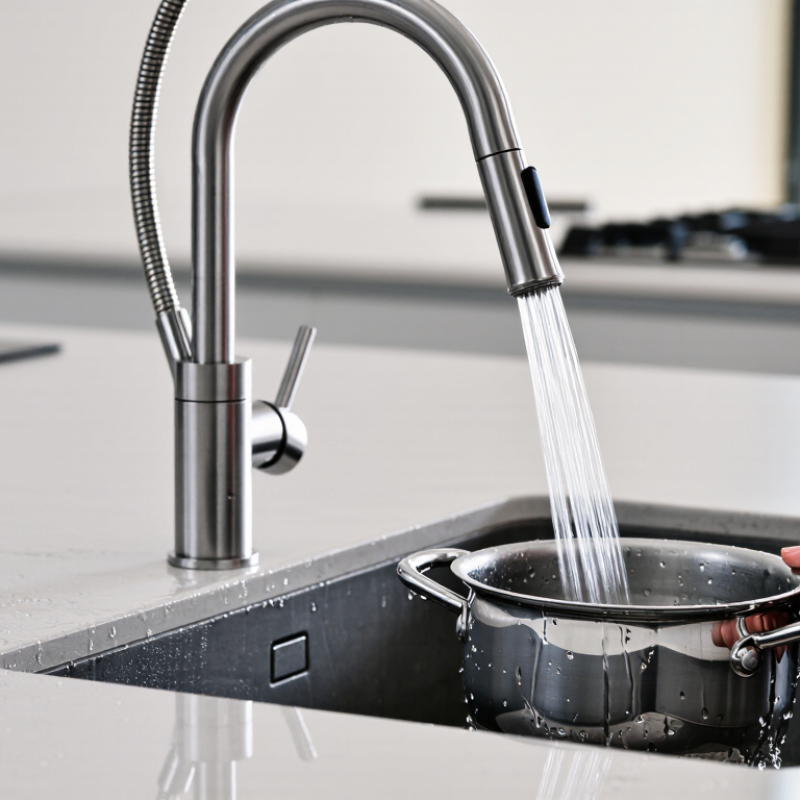
Define Your Kitchen Faucet Needs and Installation Requirements
Before comparing faucet styles, consider how you use the sink each day. A pull-down sprayer can help rinse a wide baking tray, while a higher spout leaves room for filling tall pots. If you frequently wash produce, check that the spray hose reaches every basin corner. Measure twice.
Then inspect the sink or countertop. Count the mounting holes and measure their spacing; existing holes may limit your options. Check the deck thickness and the clearance beneath it, especially if a deep sink or cabinet shelf crowds the space. Do not assume a single-hole faucet will cover unused holes without a matching deck plate.
Confirm the water-supply connection size, shutoff-valve condition, and hose length before ordering. A tape measure and flashlight make this inspection easier. If the connections are corroded or difficult to reach, ask a qualified installer to assess them rather than forcing old fittings. Also check whether the faucet includes the mounting hardware and supply lines you need. Stainless steel on the visible surface does not always mean every internal component is stainless; read the material specifications carefully. One easy-to-miss detail: a handle can hit a backsplash when fully opened. Test its swing with the available space in mind.
Understand Stainless Steel Grades, Finishes, and Construction
When comparing stainless steel grades, check the specification rather than relying on a silver appearance. Grade 304 is widely used for kitchen fixtures and offers good resistance to everyday moisture. Grade 316 includes molybdenum, which improves resistance to chlorides, though it may cost more. For most homes, water quality and cleaning habits matter more than choosing the highest grade. Check the product documentation; a polished surface alone cannot confirm the alloy.
Look closely at what is actually stainless steel. Some faucets have a stainless finish over another metal, while others use stainless steel for the body and spout. Ask for the material details, including the handle and internal components. Construction matters. A solid-feeling spout can be reassuring, but weight alone is not proof of quality. Inspect the cartridge type, mounting hardware, and hose connections, and look for a secure, even fit beneath the sink. Brushed finishes can soften fingerprints and small marks; polished finishes show them more readily. Wipe either finish with a soft cloth, following the grain when visible. One detail is easy to miss: abrasive pads can dull a finish, even when the faucet is labeled stainless. A little skepticism helps.
Compare Faucet Types, Features, and Water-Saving Options
A stainless steel kitchen faucet should suit the sink, not just the showroom. Pull-down models keep the spray head close to the basin, which helps rinse large pots. Pull-out designs can feel easier to handle in a compact sink. A high-arc spout gives more room underneath, but it may splash in a shallow basin. Measure the sink and check the spout’s reach before choosing. Small detail, big difference.
Compare the handle, spray control, and finish as carefully as the shape. A single handle makes temperature changes quick, while separate handles offer more gradual adjustment. A ceramic cartridge is a useful feature to look for because it helps control leaks over time. Brushed stainless surfaces often show fewer fingerprints than polished ones, though hard-water marks still need regular wiping. Check that the faucet’s mounting style matches the holes in your countertop.
For water savings, compare the stated flow rate, usually listed in gallons per minute, and look for a tested efficiency label relevant to your region. An aerator can mix air into the stream, reducing water use while keeping rinsing practical. It may feel weaker if your home has low water pressure. Spray and pause settings are convenient, but they do not automatically reduce consumption. Check the flow specification, not just the feature list. Some claims are vague. Try the handle if possible.
Check Compatibility with Your Sink and Plumbing
Before choosing a stainless steel kitchen faucet in 2026, measure the sink’s faucet holes and check their spacing. A single-hole faucet may need a deck plate to cover a three-hole layout, while separate handles need enough openings. Measure twice. Also check the sink deck’s thickness; a deep countertop can leave too little thread for the mounting nut. Use a flashlight.
Confirm the supply-line connections, shutoff-valve condition, and clearance beneath the sink before buying. Many faucets include flexible hoses, but their length and connector size may not match older valves. Compare the faucet specifications with the valve outlet, and never force mismatched fittings. If pipes are corroded, cramped, or leaking, ask a qualified plumber to assess them before installation. Small details matter.
Check that the handle can move fully without hitting a backsplash or window trim. For pull-down models, leave room beneath the basin for the hose and counterweight. A disposer or shelf may block its movement. It is easy to focus on the faucet’s finish and overlook this space. Recheck your measurements.
How to Choose a Stainless Steel Kitchen Faucet in 2026? Check Compatibility with Your Sink and Plumbing
These example opening diameters are exact conversions of 1¼, 1⅜, and 1½ inches—not a universal fit standard. Measure your sink hole and check the faucet’s specified hole-size range, number of mounting holes, and maximum deck thickness. Also confirm the faucet’s supply-line connections match your shutoff valves.
Evaluate Durability, Maintenance, and Long-Term Value
A stainless steel kitchen faucet faces more than occasional splashes. It handles hot pans, greasy hands, and repeated daily use. Check whether stainless steel describes the faucet body or only its exterior finish. Product specifications should clarify construction, cartridge type, and corrosion resistance. A sturdy handle should move smoothly without wobbling. Small details matter.
Maintenance affects how the faucet looks years later. In hard-water areas, pale mineral rings can form around the base and aerator. Wipe the surface with a soft cloth, then dry it; abrasive pads may scratch some finishes. Follow the care instructions for cleaners, since harsh chemicals can damage protective coatings. That takes minutes. Every few months, check the aerator for grit and the connections below the sink for moisture.
Long-term value depends on repairability as well as purchase price. Look for accessible replacement cartridges, seals, and hoses, plus clear warranty terms. A warranty is useful, but it does not guarantee easy repairs or cover every part. Consider installation, too: cramped plumbing can make a simple replacement frustrating. It is easy to overlook that. A faucet that suits your water conditions and can be serviced may cost less over time, though exact savings are hard to predict.
